Showing posts with label Science. Show all posts

Monday, November 9, 2020

We’re made of star stuff

 I was in high school when Carl Sagan’s 13 part television series, Cosmos, was aired on Doordarshan. I had always loved science, but by the end of the first episode, I was in love with Science. And with Carl Sagan too. That was the only show I watched on TV, and when the power went out on Sunday morning, I almost abandoned my atheism to pray that the power be restored before the serial started. (That the power came back on, without me having to resort to prayer only strengthened my belief that I could manage fine without religion!)

Everything about the series was incredible to the teenage me. The themes it dealt with, the footage shot on site, the special effects that showed Sagan walking though different environments, the music, and most of all the presenter. With his mix of intelligence, compassion and good looks, he was certainly my dream come true.

It was after watching how Eratosthenes calculate the circumference of the Earth that the concept of time-zones and the significance of the International Date Line started making sense to me. The whole idea of hopping across the Date Line and going from tomorrow to yesterday was fascinating for me, and for a few days, I harboured the idea that I had discovered time travel. Discussing that with my grandfather, I told him that if I kept traveling round the world from East to West, I would add days to my life. To which my pragmatic grandfather replied, “instead of adding days to your life, try making the days you have count. That would be more useful.”

Though the television series was telecast only once, the book based on it came out soon after, and that could be read and re-read till I had committed almost all of it to memory. Almost every book of popular science I read subsequently, from Bronowski’s ‘Ascent of Man’ to Hawking’s ‘A Brief History of Time’ built on the foundation that Cosmos laid.

It was Carl Sagan who, in the last episode of Cosmos, introduced me to thoughts of the nuclear war, of the position of women in science, and left me with the lingering question, “who speaks for Earth?”. The powerful mix of science, wisdom and compassion is what characterized the serial and all the other books authored by him.

These were themes he would constantly return to. His description of the R-Complex of the brain as being the site for tribalism, aggression and other reptilian behavior still helps me make sense (and forgive) of the behavior of certain people and societies.

A Glimpse of Eternity

But more than anything else, I will be grateful to Carl Sagan for showing me the window thought which I can look out anytime and catch a glimpse of Infinity. It is because of him that I can revel in my sheer Insignificance in comparison to the grandeur of Space and Time. And at the same time experience the high of knowing that as an intrinsic part of the Universe, I too am just as magnificent. Why would anyone need religion when one can experience the same intensity of emotion at the foot of Science? When you know that you are made of star stuff, you don’t really need a God.

In the vastness of Space and the immensity of Time, I am glad I met Carl Sagan when I did.

Happy Birthday, Carl Sagan.

“Look again at that dot. That’s here. That’s home. That’s us. On it everyone you love, everyone you know, everyone you ever heard of, every human being who ever was, lived out their lives. The aggregate of our joy and suffering, thousands of confident religions, ideologies, and economic doctrines, every hunter and forager, every hero and coward, every creator and destroyer of civilization, every king and peasant, every young couple in love, every mother and father, hopeful child, inventor and explorer, every teacher of morals, every corrupt politician, every “superstar,” every “supreme leader,” every saint and sinner in the history of our species lived there-on a mote of dust suspended in a sunbeam.

The Earth is a very small stage in a vast cosmic arena. Think of the endless cruelties visited by the inhabitants of one corner of this pixel on the scarcely distinguishable inhabitants of some other corner, how frequent their misunderstandings, how eager they are to kill one another, how fervent their hatreds. Think of the rivers of blood spilled by all those generals and emperors so that, in glory and triumph, they could become the momentary masters of a fraction of a dot.

Our posturings, our imagined self-importance, the delusion that we have some privileged position in the Universe, are challenged by this point of pale light. Our planet is a lonely speck in the great enveloping cosmic dark. In our obscurity, in all this vastness, there is no hint that help will come from elsewhere to save us from ourselves.

The Earth is the only world known so far to harbor life. There is nowhere else, at least in the near future, to which our species could migrate. Visit, yes. Settle, not yet. Like it or not, for the moment the Earth is where we make our stand.

It has been said that astronomy is a humbling and character-building experience. There is perhaps no better demonstration of the folly of human conceits than this distant image of our tiny world. To me, it underscores our responsibility to deal more kindly with one another, and to preserve and cherish the pale blue dot, the only home we’ve ever known.”

Carl Sagan, Pale Blue Dot

Saturday, November 2, 2019

Brahmacharini, the Dedicated Ascetic

She indulges in deep penance, thousands of years of 
deprivation and sacrifice. She gets her way. She cannot 
be swayed.

© 2018
We were returning home after winning the trophy at the National Robotic Championship. “Where did you get the idea for your project?”, the journalist asked, thrusting a microphone at Sahil.
“Oh you know, there is so much plastic pollution you know, the fish are dying, the oceans are getting polluted. We wanted to make something useful. So we thought of making this robot that will clean our oceans.”
“Most of the other teams made robots that can be used it gaming. Were you not tempted to do it?”
“No, not at all. You know. The fish are very important. And the oceans are getting polluted. So we wanted to do something useful.”
Did Sahil have no shame. How could he stand there telling those blatant lies? I still remember the time when we were trying to come up with a project. The boys both wanted to make a robot that would fetch can carry things for them in the house. But I was determined to make something useful.
I tried to appeal to our teacher, but he told me to sort it out within the team itself. With barely a week to go for the competition, I tried to convince them one last time. “You know one of the biggest problem in the world today is that so much of the plastic that we can recycle ends up in the ocean. Why don’t we make a robot that can identify water bottles from a conveyor belt and sort them for recycling. It would be so useful.”
Neither of them was convinced by my argument, but since they knew I would end up doing most of the work, they finally relented.
At least Rahul tried to help. He made the body in which the circuitry was housed, and he helped weld the claws that actually picked up the bottles. All Sahil did was make snide suggestions about how we should give the robot a narrower waist, because women were better at cleaning up stuff than men!
Both of them disappeared during the exhibition. Our teacher and I took turns demonstrating the robot. Twice the robot malfunctioned, but I was able to make the necessary adjustments in the circuitry and fix it.
I knew the judges liked the robot, but never dreamt that we would win the Championship. When we went up to receive the trophy, Sahil was the one who held it high for the photographers. I didn’t mind- he is the tallest of us and could hold it higher.
“Tell  us a little more about what your robot does”, the journalist continued.
“You know, it helps clean plastic pollution. It picks up plastic, you know.” Sahil looked around, hoping I would pitch in, but the journalist was done with us.
“Wish you all the best. Hope you win many more such championships.” She flashed him a smile, then smiled at Rahul and moved it. It was almost as if I didn’t exist.
“That was fun”, said Sahil. “I can’t wait to show this trophy to my family. Mummy is having a party tomorrow- all the uncles and aunties will come to congratulate me. I’m sure some of them will even get me gifts- I hope it is money.”
I guess I would have to wait for my turn to take the trophy home to show my mother. My mobile rang-
“Baba, there is no electricity in the bedroom and I can’t reach the electrician. Will you be home soon, so you can fix it?” I smiled. At least my mother knew what I was capable of.
______
I am Brahmacharini, the Devoted Student. The second manifestation of Nav Durga. I am every woman in STEM.

Friday, January 10, 2014

Science can be Fun- Day 4 of #100happydays


“Do we have vinegar at home?”, asked the older one casually.
 “I don’t feel like eating my egg”, said my younger one. “Can I have it to play with?”
I knew where this was leading. They had been pouring over a book called “Freaky Science Experiments”, and wanted to try one where you used vinegar to dissolve the shell of an egg. There was no real reason why they should not do it, so I helped them set the experiment up.
Four days later, they are still fascinated by the bouncing egg they are creating. Science can be great fun!
 

---------
Can you be happy for 100 days in a row. Sign up for #100happydays
Follow me on Instagram- nuts246

Sunday, October 7, 2012

Separate Issues from Personalities


“God does not play dice.”
“Stop telling God what to do.”
Even people who do not know what Albert Einstein and Niels Bohr were arguing about have heard of this famous exchange. Einstein could never quite reconcile himself to Quantum Mechanics as articulated by Bohr, even though (ironically) it was his work that led to it.
Till the end of their days, Einstein and Bohr argued about Nature’s Laws- neither willing to give in to the other. Yet, they continued to have the highest regard for each other.

Why do we find it so difficult to separate issues from personalities?
 Today's google doodle commemorates what would have been the 127th birthday of Niels Bohr. 


“An expert is a person who has made all the mistakes 
that can be made in a very narrow field.”
- Niels Bohr
October 7, 1885- November 18, 1962
______
This is the fourth year that I am going to be a part of NaBloWriM. The Plan is to elaborate (in 100 words) on a quote that touched my heart- let's see how far this takes me. If I can tie it in with the writing prompt, so much the better!

Wednesday, August 29, 2012

The Man on the Moon


On Sunday, I took my kids to the terrace, made them hold up their tiny thumbs, shut one eye, and blot the crescent moon out. “But if the moon is so small, how did Neil Armstrong walk on the moon?”, they asked.
“Don’t things look smaller when they are far away? The moon is actually very big- it seems so small because it is so very far away.” When they had digested that, we spoke about the stars, and of how very big the Universe was.
“So big?” they asked in wonder. Yes, and we are a part of it.
______
"Science has not yet mastered prophecy. We predict too much for the next year 
and yet far too little for the next 10."

Neil Armstrong
(August 5, 1930 – August 25, 2012 )
Requiescat in pace

Thursday, March 15, 2012

Happy Birthday, one day late

The world knows him as the man who revolutionalized Science. While most people do not claim to understand his work, he is deemed influential enough to have been named the Man of the Century by Time magazine.

But to me, Albert Einstein is more than a great scientist. He is a man who never shied away from standing up for what he thought was right. His words, “the world is a dangerous place to live; not because of the people who are evil, but because of the people who don't do anything about it” will continue to ring true forever.

_____
A drabble is a story told in exactly 100 words.

Monday, July 12, 2010

What is inside?


“What is inside the soap?”
“More soap.”
“What is inside the more soap?”
“Even more soap.”
“What is inside the even more soap?”
“Bubbles.”
“What is inside the bubbles?”
“Air.”
“What is inside the air?”
“Molecules.”
“What is inside molecules?”
“Neutrons, protons and electrons.”
“What is inside that?”
“Sub-atomic particles.”
“What is inside that?”
“If you find out, you might win the Nobel Prize for Physics.”
“What’s that?”

If and when the four year old decides to become a scientist like his great grandfather, I wonder if he would remember that conversation he had while his mother was bathing him.


_____
A drabble is a story told in exactly 100 words.

Saturday, April 24, 2010

U for Universe

This was yet another of those letters where I couldn’t find anything to write about.
U for Uniforms? My sons’ obsession with drawing superheros? But it is costumes that they wear, not uniforms, isn’t it?
U for the Underworld? But that is something I know next to nothing about- the Mario Puzo variety, and the one that Osirus presides over!
U for Underground? I would have loved to write about possible solutions to the mass transportation problem in my city, but considering the city is only inches above the high tide mark, no solution can take place Underground.
U for YouTube? Not only would that be cheating, I am a total newbie to the site, and would have nothing to contribute.
U for Umbrella? I could write about the fun of splashing through puddles with nothing with a brightly coloured umbrella protecting me from getting drenched. But wouldn’t it make more sense to do that post AFTER the monsoons start?

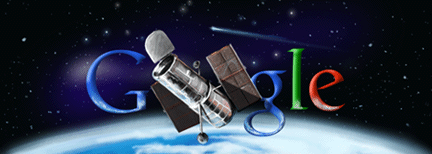
I was no closer to finding a word for the letter, when I logged onto google and found this –
Today is the 20th Anniversary of the Hubble Space telescope. I had my U-post. “U for Universe”.

I had just taken my school-leaving exams when the Hubble Telescope was shot into space. And in the months between leaving school and starting college, the Hubble Space Telescope became almost an obsession. Those were the days before the Internet and when you had only one channel on TV, so news was hard to come by. But I still managed to devour every tiny snippet of news that came out. I remember cheering when the Telescope was finally shot into space, and I remember groaning in despair when we got the news that one of the mirrors were not functioning, which would adversely affect the quality of images the telescope could pick up.
Somewhere along the line, I lost interest in the Hubble Telescope. I was vaguely aware of the fact that NASA had spent an awesome amount of time and effort in repairing the non-functioning mirror, and the spirit soared whenever I got to see some of the images sent back by the telescope. But I no longer followed the progress of Hubble in quite the breathless way in which I used to do.

Here are just some of the images that the Hubble Space Telescope sent back over the years.

NGC 2818, a planetary nebula

Individual stars at the centre of the globular cluster, Omega Centuri.
NGC 3603, an open star cluster
Whirlpool Galaxy, a face on spiral galaxy much like our own


Is it even possible not to be awed by the immense beauty of the Universe? And when you are in touch with the Universe, do you feel humbled because you are so insignificant in the larger scheme of things, or do you feel a surge of power because you realise that you are an intrinsic part of something so Grand?

Monday, January 4, 2010

An apple for Sir Issac

Today's google doodle featured an apple branch laden with fruit. One fell down, and reminded me that Sir Issac Newton was born today!

Legend has it that Newton was sitting under an apple tree thinking of his next meal when an apple fell on his head, and made him come up with the Theory of Gravitation. A story that has been told and retold so often, nobody even pauses to think how anyone could have derived those equations with nothing more to go on than a solitary fruit making a short journey to the earth.

A purist will tell you that it was by observing the motion of the planets around the sun that Newton derived the laws of gravitation. And they would be right.

But like the bear that Teddy Rosevelt could not bring himself to shoot, the apple that fell on Newton's head has assumed gigantic propotions. Whether it is true or not, it is perceived to be so. And as long as seeing the apple makes people think of gravitation, if only for a moment, why not?

After all, wouldn't we rather say that we see through our eyes, than get into a long and convoluted story about images being formed on the retina, being carried as nerve impulses to the brain, and the brain cells registering the impression of 'sight'.
I am all for exactness, but sometimes being colourful is more fun than being merely exact.

And Happy Birthday Sir Issac. We see the world much better because you found giants who allowed you to climb onto their backs.


Posted by Picasa

Wednesday, October 7, 2009

Turning Turtle

The other day, a wildlife photographer was telling me about how the sex of certain species of sea turtles is determined by the temperature of the water where the eggs incubate. ‘Hot gals, cool guys’ is how she described it. Normally, I would have dismissed it as urban legend, but she hadn’t just heard about it. She, and a dozen others, had actually randomly divided turtle eggs into two groups, which had then been kept at different temperatures- not even one egg had hatched differently from expected.
It flew in the face of all the genetics I had been taught in school, and which I learnt subsequently. The sex of any living organism is determined by the sex chromosomes, which are decided at the time fertilization. How then could the conditions under which the embroy fertilizes have any implications on the sex of the turtle?

I tried using the Internet to find out why it happened, but all I found were articles corraborating the phenomenon. Finally, I came up with a theoryof my own. Maybe male turtles have three sex chromosomes instead of two - XXY. All turtles start off male, but heat kills off the weaker Y chromosome, so female turtles with two X chromosomes hatch from eggs incubated at higher temperatures. Scientifically, it is as plausible an explanation as any other, and I am sticking to it till someone comes up with something more convincing.

Which brings me to the point of the entire post. Anyone who frequents my blog knows how much I love drabbles and drabbling. Normally, my drabbles almost write themselves. But while working on the story for this Sunday, something strange happened. My character refused to behave herself - she was determined to drag the story to something much longer than 100 words, and did. Since I have been attempting to do something longer for a long time, I am not complaining.

But I wonder if it is normal? When I created my character, she was supposed to be a drabble, but she seems to have taken over and done just what she wants. Does that happen, and when it does happen, how do you cope? Is there some way you can continue to exercise control the way nature does with turtles?

Tuesday, September 1, 2009

The Double Helix

I’ve been wanting to read John Watson’s “The Double Helix” for a very long time, but have never been able to get my hands on a copy. The few bookstores that had heard about it, never seemed to have it in stock, and all efforts to get them to order the book for me proved equally futile. And then, I found the book online and immediately ordered myself a copy.

I could barely wait to tear the packaging off before digging into the book. And then, I was almost immediately disappointed – disappointed enough to throw the book aside for over a week. To me, “Surely you must be joking, Mr. Feynman” sets the bar for popular autobiographical works by a scientist, and “The Double Helix” did not even come close either in terms of description of science, or personality of the author.

When I returned to the book with diminished expectations, it was not so bad. But even after making allowances for the self-depreciating style employed by Watson, their approach seemed almost cavalier. Crick and Watson seemed more concerned about beating others to the discovery than making the discovery themselves, and to achieve that end they were willing to grab data from anywhere with or without the other person’s knowledge. Worse, they did not even seem to do that well, with Watson not even being sure about the order of magnitude of a particular result when reporting back on it.

It was only in the final stages that they seemed to be doing something that sounded like ‘real science’, and even then, one could never find out if they used the less popular tautomeric structure of the ketones because they were convinced those were better representations, or if they did so only because they better suited the results.

Overall, a book that left me feeling quite disappointed, which may or may not have something to do with my expectations from the book.

But it was wonderful to get reacquainted with the structure of the DNA molecule, and to experience anew the thrill of seeing something so beautiful and elegant. And for that alone, I will cheerfully re-read the book selectively.

Wednesday, February 18, 2009

Pluto was a planet


“Planetarium, planetarium. Eight planets in my planetarium”, sang my sons while putting together a Solar System jigsaw puzzle.

It was an idyllic moment- the likes of come but rarely- both kids gainfully employed, doing something constructive, and enjoying each other’s company. And yet, there was a tinge of regret.

Regret for that little planet who always tagged along behind his considerably bigger brothers, but was now barred from that group. Pluto, who’s identity as the ninth planet had so cruelly been snatched away.

Soon, my kids will be old enough to ask why Pluto is on their Solar System puzzle.


Posted by Picasa

Monday, December 29, 2008

The real giants

"Mamma, tell me the story of Tiger Bravo", my older one asked.

"Who?"

"Tiger Bravo. The giant, Tiger Bravo. The one with the golden nose."

Ah, that 'Tiger Bravo'!!!

I launched into a story of Tycho Brahe, the giant of science, who lost his nose in a fight, before realising that fighting did not solve any problems, and who then devoted himself to studying the stars and so became a very powerful giant.

Stretching the truth, I know, but the kids were impressed to know that you did not have to do exercises to become a giant - you could do that by solving number problems too.

Tiger Bravo led to Johannas Kepler, and today I am committed to telling them the story about the third giant - Issac Newton.

Kids these days adore their superheros, and even three-year olds know everything there is to know about every one of them. Why then, has nobody thought to make real life heros into comic book superheros. I am sure they would really take off.

Saturday, November 15, 2008

At the Planetarium

My older one had been wanting to visit the Planetarium for weeks. Knowing how difficult it would be to schedule it into a normal weekend, I’d promised to take him during our week in Delhi. The big day arrived, dozens of things went wrong we reached the ticket window barely 20 minutes before the show was supposed to start. I was sure we would not get tickets, and kept trying to prepare my son for the disappointment of having to wait another day to ‘see the stars’.
The lady at the ticket counter seemed not to understand what I meant when I asked if tickets were still available, but since she produced the tickets without much ado, I did not dwell too much on her apparent confusion. We ran into the Planetarium, and found ourselves surrounded by beautiful photographs of the night sky taken from various historical sites, memorabilia from Rakesh Sharma’s space visit, paintings made by children of the Chandrayan expedition, and nothing else. There was not a single person around – not even one.
Minutes before the show was to begin, people started tricking in – three school kids, a man my age and his mother, a man with two kids of school going age. That’s it! Including my not yet three year old, there were exactly a dozen people in a Planetarium that could easily seat at least two hundred people.
The show was beautifully executed. Complex concepts were explained in very simple language. There were things that even a self-confessed astronomy buff like me learnt for the first time. And going by some of the references, the commentary had been updated in the last month. But, there was practically nobody to see it.
Malls are always crowded with people who are there only to have a good time. Why can some of those people not visit a Planetarium sometimes?

Wednesday, September 17, 2008

The Large Hardon Rap

I am sure there is nobody in the planet with access to an e-mail account that hasn’t’ yet seen the ‘Hardon Rap’ video. Till the video came out, everyone who was talking about the Large Hardon Collidor was taking about how the world would end the moment it was switched on.

It didn’t seem to matter to anybody that it would take weeks for actual data to come in. Or that the black holes that would be created would be too small to affect anything except the experimental readings. Fed on a staple diet of science fiction, and science fiction that is not very high on the science part of it either, people could only think mad scientists creating the LHC so they could unwittingly annihilate the known Universe.

And then Kate McAlpine’s rap video started doing the rounds and pretty soon people were hooked -


The music was catchy, the lyrics accessible and, most importantly, the science bang on.

So much of Particle Physics is pure mathematics, that even most science graduates struggle to grasp it. Writers of popular science have always suffered from either of two problems – simplify so the concepts are accessible and you run the risk of oversimplification, or try to keep it accurate and not reach the desired audience. It is a tightrope walk, and most people have chosen the former part. But few have done so as effectively as the 23 year old science communicator who penned the lines -

“You see particles flying, in jets they spray

But you notice there ain’t nothin’, goin’ the other way

You say, “My law has just been violated – it don’t make sense!

There’s gotta be another particle to make this balance.”

And it might be dark matter, and for first

Time we catch a glimpse of what must fill most of the known ‘Verse.”

or

“Antimatter is sort of like matter’s evil twin

Because except for charge and handedness of spin

They’re the same for a particle and its anti-self

But you can’t store an antiparticle on any shelf

Cuz when it meets its normal twin, they both annihilate

Matter turns to energy and then it dissipates”

With lyrics so simple, it is hard to not get the basic message. Naturally, therefore, nobody is talking about the world coming to an end anymore – they are busy rapping away.

I would always be skeptical when I heard stories of how one song changed the course of human thought. I now believe those stories – Kate McAlpine’s slightly quirkily named Hardon Rap can take its place along with Bob Dylan’s Blowing in the Wind.

Sunday, September 7, 2008

Schrödinger's Cat

Am I alive or dead? I do not know.
They tell me that till they verify if I am alive or dead, I am simultaneously alive and dead.
How could that be?
I can either be alive, or dead. I cannot be both!
Or can I?
I am alive now! I may soon be dead, but right now I am alive, even if nobody knows it but me.
What matters more – my being something, or their knowing it?
I am confused?
Why did it have to be me? Why could Uncle Erwin not have picked Rover for his thought experiment?


_____
Drabble (n) - an extremely short work exactly one hundred words in length. The purpose of the drabble is brevity and to test the author's ability to express interesting and meaningful ideas in an extremely confined space.


Painting by Russel Baker - take from his site

LinkWithin

Related Posts with Thumbnails